Author: ZANEC
-
ZANEC Press Statement on the International Day of the Girl Child
Zambia National Education Coalition (ZANEC) is pleased to join the global community in commemorating the International Day of the Girl Child which falls on 11th October. This international commemoration allows us to reflect on our achievements and shortcomings in addressing the challenges that girls are facing in realizing their right to education, and in ensuring a better tomorrow for them.
The theme for this year is “Girls’ Vision for the Future”. The theme is reminding us to empower girls, amplify their voices, and support them through progressive strategies and policies that ensure a better future for our Girls. Girl child education is vital to the growth of a nation as they will be well equipped to contribute effectively to the family, community, and national economic development as well as the attainment of the Sustainable Development Goals (SDGs) by 2030. Indeed, as one famous African proverb states “If you educate a man, you educate an individual, but if you educate a woman, you educate a nation”. Therefore, it is good for Zambia to ensure that all girls are educated regardless of their ability, social, cultural, and economic status and location. As this will not only contribute to national development but also reduce high poverty levels among women and enhance household productivity and financial independence.
Supporting the vision of the girl child is critical to realizing a future where every girl can reach her full potential and create lasting change in our country. To ensure a future where every girl has a right to a safe, educated, and healthy life, free from the barriers of discrimination, inequality, and violence. Therefore, we need to invest in the education and well-being of girls as our future leaders, innovators, and change-makers who will drive social and economic progress. By promoting their talents and providing them with equal opportunities, we enable girls to fulfill their dreams, break cycles of poverty, and contribute meaningfully to national development.
It is sad to note that despite, many international declarations, development goals, and the government’s significant efforts to promote girl child education, globally 122 million girls are out of school, and women still account for almost two-thirds of adults unable to read and write. In Zambia, 29% of girls get married before the age of 18, and currently women represent only 14.97% of Members of Parliament an indication that gender disparity in education and key decision-making positions continues to exist.
Furthermore, it is unfortunate that the cases of early marriages and teenage pregnancies account for the large number of girls who are out of school. It is also evident that more girls in rural areas still struggle to access learning opportunities, due to inadequate infrastructure, teacher shortages, and negative cultural norms and practices that continue to affect girls’ education. According to the 2020 Education Statistical Bulletin produced by the Ministry of Education, as a country, we have 105,700 girls who are out of school as a result of the high drop-out rate. Additionally, 16,491 girls got pregnant, and only 7,954 were readmitted representing a 48.4% readmission rate.
The above statistics are an indication that more needs to be done so that a girl child has an equal opportunity for quality and equitable education to safeguard her future. We, therefore, take this opportunity to urge the Ministry of Education and all other relevant stakeholders to leverage international instruments and focus on the effective implementation and enforcement of various national policies and Acts that safeguard, protect, and promote girl’s tights such as the Children’s Code Act No.12 of 2022, Child Participation Policy, Gender Equity and Equality Act No. 22 of 2015, Anti Gender-Based Violence Act No. 1 of 2011, the Free Education Policy and the Re-entry Policy Guidelines among others.
Finally, we wish all our girls a fruitful commemoration of the 2024 International Day of the Girl Child.
For/ZANEC
George Hamusunga
Executive Director
-

ZANEC PRESS STATEMENT ON WORLD TEACHERS’ DAY
The Zambia National Education Coalition (ZANEC) is pleased to join all teachers worldwide in commemorating World Teachers’ Day, which falls on October 5th. We are glad that the government of the Republic of Zambia through the Ministry of Education has rescheduled this year’s World Teachers’ Day celebration from Saturday 5th October, to Friday, 4th October, 2024 to ensure full participation by all stakeholders. This day is dedicated to celebrating all our educators in public schools, community schools, grant-aided schools and private schools in our early childhood education centres, primary schools, secondary schools, tertiary institutions, and adult literacy centres. World Teachers’ Day is special because it serves as a reminder of the vital role teachers play in the education and skills sector. It is an opportunity to celebrate how teachers are transforming our society while also reflecting on the support they need to fully realize their potential.
This year’s World Teachers’ Day theme “Valuing Teacher Voices: Towards a New Social Contract for Education” focuses on recognising and appreciating teachers’ voices. This theme highlights the need to address the systemic challenges teachers face and establish a more inclusive dialogue about their role in education. It also underscores the urgency of calling for and attending to teachers’ voices to address their challenges and, most importantly, to acknowledge and benefit from the expert knowledge and contributions they make to education.
As ZANEC, we recognize the urgent need to transform the teaching profession into a more attractive and valued career in our country. We take this opportunity to advocate for a dignified and respected teaching profession. To achieve this transformation, it is crucial that we actively listen to teachers and incorporate their insights into decision-making processes that concern them. Through fostering an environment where teachers feel respected and empowered, we can create a supportive framework that enhances their ability to inspire and educate effectively. The education system, communities, and families have to recognise, appreciate and actively support teachers as they are key to meaningful social and human development because of the pivotal role they play. This World Teachers’ Day therefore serves as a reminder that when we value and invest in our teachers, we not only uplift the profession but also enrich the educational experience for all learners.
Together, we can pave the way for a brighter future in education, where every teacher is recognized as a vital contributor to the success of our learners and society as a whole.
Therefore, ZANEC is of the considered view that it is important to implement fully the International Labour Organisation (ILO)/United Nations Educational, Scientific and Cultural Organization (UNESCO) Recommendations concerning the Status of Teachers that were adopted in 1966. Among other recommendations includes:-
- All aspects of the preparation and employment of teachers should be free from any form of discrimination on grounds of race, colour, sex, religion, political opinion, national or social origin, or economic condition.
- Working conditions for teachers should be such as will best promote effective learning and enable teachers to concentrate on their professional tasks.
- Teachers’ organizations should be recognized as a force which can contribute greatly to educational advancement and which therefore should be associated with the determination of educational policy.
In line with this year’s theme, ZANEC also calls on the government:
- To create inclusive platforms where teachers can participate in shaping educational policies. Involving teachers in decision-making processes ensures that we develop policies that reflect the realities of both teachers and learners.
- To continue providing platforms for training and professional development opportunities for all teachers, which are essential for enhancing their skills.
- To ensure competitive remuneration, decent accommodation, and good conditions of service for teachers. This is vital for attracting more qualified and motivated individuals to the profession, thereby addressing the challenge of teacher shortages.
We take this opportunity to appeal to the Ministry of Education to continue the recruitment of teachers to reduce the high teacher-to-pupil ratio in schools, which will enhance the quality of learner outcomes. Additionally, the Teaching Service Commission must ensure that teachers’ conditions are adequately addressed in both public and private schools, particularly where adherence to labour laws presents challenges.
Finally, ZANEC extends its wishes to all teachers to have a safe, happy, and successful commemoration of the 2024 World Teachers’ Day.
For/ZANEC
George Hamusunga
EXECUTIVE DIRECTOR
-
ZANEC PRESS STATEMENT ON THE 2025 NATIONAL BUDGET ISSUED ON THE 1ST OCTOBER 2024
The Zambia National Education Coalition (ZANEC) has reviewed the 2025 National Budget that was presented to Parliament by the Minister of Finance and National Planning Dr. Situmbeko Musokotwane on Friday, 27th September 2024. Overall, we are pleased with the following education budget measures: –
- We are pleased that the government has completed construction of 151 secondary schools out of 317 that are being constructed cross the country. Our hope is that the construction of the remaining schools will be completed soon so that we can increase access to free secondary education.
- It is good that government is also constructing 480 early childhood education centres, earmarked for completion by the end of 2025 as Early Childhood Education is critical for the development of foundational skills.
- ZANEC is also happy that 812,598 desks have been procured, out of which 712,562, or 87 percent, were acquired using Constituency Development Fund (CDF).
- Government’s commitment towards addressing the challenge of accommodation in public universities is welcome and should be applauded. The planned construction of 58 hostel blocks across the eight public universities with a total bed capacity of 9,280 will go a long way in addressing the accommodation crisis in our public universities.
- It is pleasing that the government under TEVET has completed the construction of Mporokoso and Lundazi Trades Training institutes and the student hostels at Ukwimi and Chipata Trades; and for equipping them with state-of-the-art training equipment.
- ZANEC is pleased that K150 million has been allocated for the implementation of the new national education curriculum as the curriculum is progressive and will promote lifelong learning, entrepreneurship, and practical skills.
- ZANEC welcomes the increase in the allocation to the School Feeding Programme to K534.4 million in 2025 from K 7 million in 2024 as it will keep learners in school and improve learning outcomes.
To this effect, ZANEC would like to recommend the following measures going forward: –
- ZANEC notes with sadness that the allocation to the education sector has reduced from 15.4% in 2024 to 14.5% in 2025.
It is important as we have stated before that 20% of the total budget should be allocated to the education sector in line with the SADC and Cairo Protocols on Education.
- This will allow the country to make adequate investments in improving quality education for all. It will also aid in achieving Sustainable Development Goal (SDG) 4.
- The recruitment of 2,000 teachers in 2025 is welcome; however, we recommend that the recruitment takes place in the first quarter of 2025. Otherwise, the delayed recruitment and replacement of teachers has had a negative impact on the teacher/pupil ratio. For instance, the delayed recruitment of the 4,500 teachers that were planned for in 2024 is not good for the sector.
- Although the CDF allocations are welcome, government needs to address the bottlenecks that are leading to its underutilisation. Continuing increasing the CDF without addressing the capacity gaps is counterproductive.
For/ ZANEC
George Hamusunga
Executive Director
-
ZANEC 2025 PRE-BUDGET PRESS STATEMENT ON THE EDUCATION AND SKILLS SECTOR
The Zambia National Education Coalition (ZANEC) is pleased that the 2025 National Budget will be presented by the Minister of Finance Hon. Dr. Situmbeko Musokotwane (MP) on Friday 27th September 2024. It is in this vein that we would like to highlight our expectations on the 2025 national budget detailed in this statement which were also submitted to the Ministry of Finance and National Planning.
Specifically, our expectations on the revenue side of the budget are as follows:
- Introduce an Education Levy that can help with resource generation for the education sector.
- Ease the logistical burden of tax compliance for Micro, Small and Medium Enterprises (MSMEs). Through the use of innovative low-cost solutions that can enhance tax compliance.
- There is need to improve awareness of the tax system and contributions from the informal sector including the Small and Medium Enterprises.
- The Government should remove the deductable mineral royalty for corporate income tax assessment purposes to mitigate the current loss of an estimated K3.2 billion which can be redirected towards the education sector.
- The PAYE tax bands should be adjusted to introduce additional brackets for more progressive taxation: This proposal considers the high cost of living in the country, with inflation at 15.5% as of August 2024. Additionally, the Jesuit Centre for Theological Reflection (JCTR) reports that the Basic Needs and Nutrition Basket (BNNB) for August in Lusaka rose to K10,669.33, for a family of five.
- Reduce FISP expenditure by 50% and redirect the funds towards empowering Zambia National Service (ZNS) among others to increase their production of maize.
- Reduce VAT from 16% to 13% and increase non-refundable taxes. The ZRA continues to face challenges due to the inability to trace back the transactions of claimed input VAT (refund VAT) filed by buyers due to the size or formality of suppliers.
Expectations on the expenditure side of the budget are as follows.
- It is imperative to devote a minimum of 20% of the national budget towards the Education sector. This will aid in achieving Sustainable Development Goal (SDG) 4 and commitments made during the Transforming Education Summit (TES) 2022, which are essential for the attainment of equitable and quality education for all.
- Ensure that at least 10% of the total number of teachers deployed annually should be Early Childhood Education (ECE) teachers and caregivers.
- Increase allocation for ECE grants from 2.28% to 4% in the 2025 budget. The current allocation per school is not adequate.
- Provide for construction of more infrastructure for secondary schools; Boarding facilities and teachers’ houses to address the challenges of inadequate secondary, boarding schools and decent houses for teachers.
- Increase the allocation to the skills and tertiary sector from 8.7% in 2024 to 12% of the total education budget in 2025.
- Increase the percentage allocation to Youth Adult Literacy and Education (YALE) to at least 2% from the current 0.2% of the total Education budget which has remained constant for 3 years. This will help operationalise the YALE Policy; employ specialised adult learning instructors; conduct sensitisation on YALE lessons; provide more teaching and learning materials, provide appropriate skills training.
- Allocate resources aimed at promoting inclusive education to help promote access to education for learners with disabilities and learners with special education needs.
I thank you.
For/ZANEC
George Hamusunga
EXECUTIVE DIRECTOR
-
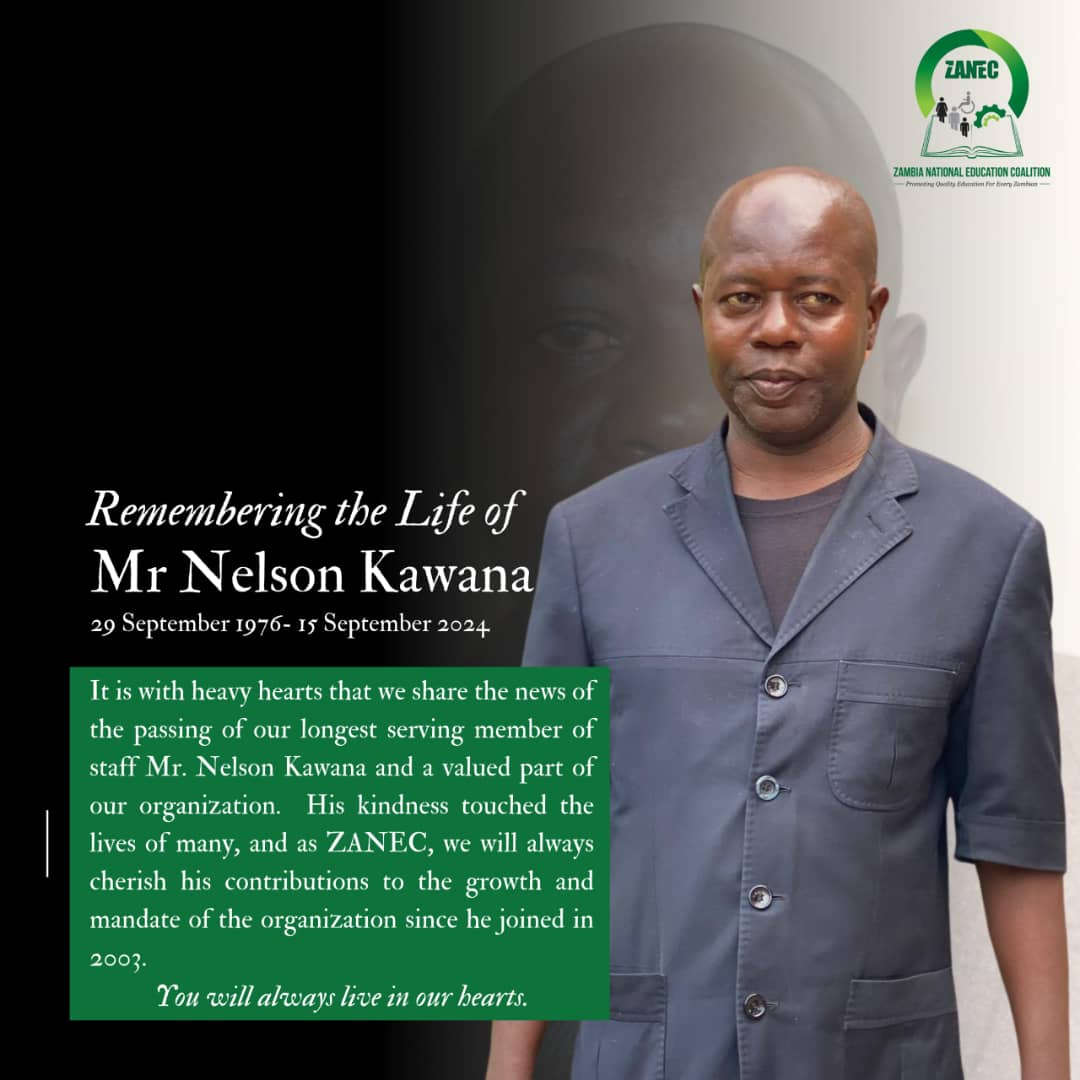
Remembering the life of Mr Nelson Kawana
It is with heavy hearts that we share the news of the passing of our longest serving member of staff Mr. Nelson Kawana and a valued part of our organization. His kindness touched the lives of many, and as ZANEC, we will always cherish his contributions to the growth and mandate of the organization since he joined in 2003.Mr Nelson Kawana Started working at ZANEC on 21st November 2003 as Office Assistant, the position held up to the time of his untimely demise. During his time at ZANEC, he contributed significantly to the growth of the organization as he was the longest serving member of staff. He was a loyal and dedicated member of staff, always ready to do his duties and went an extra mile to see his work done on time.We express our gratitude for the life that God allowed us to spend and work with Mr Kawana.May his Soul Rest in Eternal Peace.